By Josh Timewell
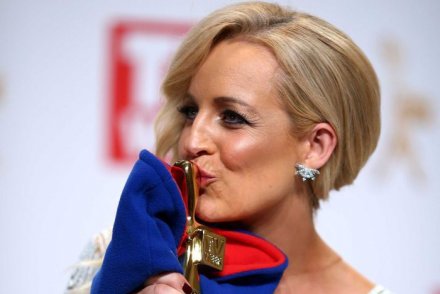
Channel Ten personality and Gold Logie winner Carrie Bickmore spent her time on stage speaking about brain cancer in Australia at last week’s TV Week Logie Awards.
Her husband, Greg Lange, passed away in December 2010 after a long battle with the disease.
During her speech, she donned a blue beanie as a tribute to her late husband and started the hashtag #beaniesforbraincancer, which became a trending topic in Australia on both Twitter and Facebook.
She also challenged the public to wear beanies and post their responses on social media.
To all these who took up the challenge today THANKYOU. I am blown away. Keep the selfies coming. #beaniesforbraincancer
— Carrie Bickmore (@BickmoreCarrie) May 4, 2015
The trend received responses from the likes of former Australian PM Kevin Rudd, along with hundreds of celebrities and television shows.
Better late than never! Great work @BickmoreCarrie #BeaniesForBrainCancer pic.twitter.com/W2kvm0NIAr — Kevin Rudd (@MrKRudd) May 5, 2015
Presenters from almost every major Australian network wore beanies of their programs on Monday.
Today, there is no cure for brain cancer but it is becoming increasingly prominent. It is one of the lesser-researched cancers and receives a small amount of funding, in comparison to other cancers like leukemia or breast cancer.
Spokesperson for the Cure Brain Cancer Foundation, Clemency Norris, said social media is imperative, as scientists search urgently for effective treatment.
“The awareness when it comes to brain cancer is key because it drives funding into research for new treatments.
“We can barely treat it at the moment because the treatments that we have simply don’t work on people,” said Ms Norris.
According to information from the Cancer Council, brain cancer is the leading cause of cancer deaths in people 39 years and under.
Each year, around 1400 people of all ages are diagnosed with the disease, with around 1100 deaths. On average, only one in five people who are diagnosed with the disease have a survival rate beyond five years.
Data from the Australian Bureau of Statistics shows that in children, brain cancer is the leading cause of all deaths.
Brain cancer patients are also the most expensive to treat, as the disease ‘is highly debilitating, affects people in their prime and often means family members cannot work if they become carers,’ according to the Cure Brain Cancer Foundation.
Executive Officer for The Royal Melbourne Hospital Neuroscience Foundation Peter Davis said that it is money that is holding back progress into treatment and one day, a cure.
“A lot of people are affected by leukemia and other diseases, but fortunately they have a much better survival rate. The main reason is that it keeps on recurring…unfortunately there’s only a certain amount of brain that you can cut away.
“We have about 24 researchers and a whole range of PHD students through the university that we fund as well,” said Mr Davis.
He said the campaign was a tribute to the power of social media, with the website’s activity going through the roof not only after her speech, but each time it was mentioned on other programs over the following days.
 Professional Dude- Josh Timewell